Stage
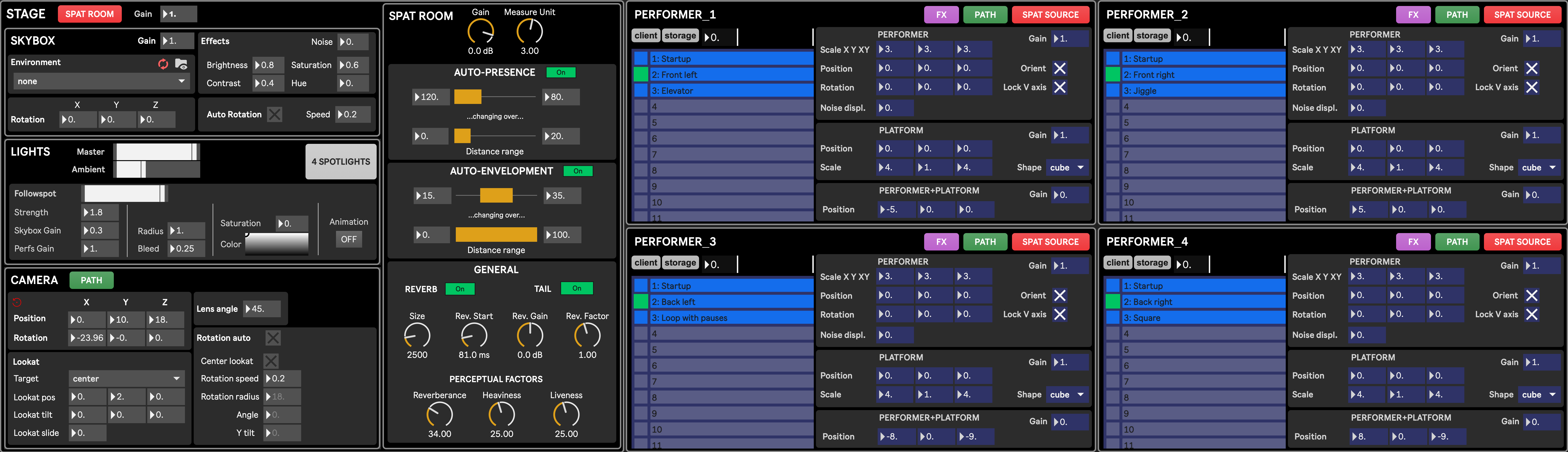
The Stage is at the heart of the Visual Stage app, as it is the initial reason for its existence: a virtual 3D environment in which real performers can be projected and evolve through space and time as in a carefully crafted mise-en-scène.
To further embed performers into the scene, they are typically positioned on 3D stage platforms. These platforms give the illusion of groundedness and prevent the performer from appearing to float unrealistically within the space. Once on stage, each performer becomes a mobile visual element: their position, size, effects, and motion can be remotely controlled, allowing dynamic visual interaction beyond the limited range of physical movement they have in their studio.
Central to the spatial illusion is the Skybox: a 360° backdrop that envelops the entire environment. Being made of equirectangular images, they can be captured from real places as well as abstracted and artistically manipulated, designed to avoid realism in favor of an atmospheric, dimension-enhancing space. This choice would shift the setting away from specific locales and into a dreamlike, expressive landscape appropriate to the poetics of the Visual Stage app.
Lighting plays a key role in completing the scene. The system includes a primary spotlight with parameters for strength, radius, color, and edge softness. An ambient light bathes the Skybox with background illumination. Each performer has access to a dedicated overhead fixture, allowing for refined focus, intensity, spread, angle, and color control. Lights can be targeted individually or collectively to emphasize specific performative or visual dynamics.
With support for up to four concurrent performers, and provisions for rotating cast members from offstage, the online mise-en-scène allows for fluid and expressive staging that adapts to the needs of a live, distributed performance environment.
Finally the whole scene is captured through the eye of a fully controllable Camera, bringing cinematographic possibilities to the stage. Positioning the camera and performers can be done either by manually entering their position coordinates, or by using the 3D panner tool.
Together, these elements form a visual grammar of the Telematic Theater: a hybrid space where light, texture, scale, and movement converge in real time to produce a new kind of theatrical experience.
The stage is visible from its dedicated Stage layout, as well as in the Mixer layout through smaller sized placeholder modules giving quick access to the various parts of the Stage.